Built in-house · Owned end to end · Updated August 2026
Every screen, every workflow, every AI agent in this stack was designed and built inside Cube Group — one brand system, one connected pipeline, from a candidate's first click to a leader's live field dashboard.
The ecosystem
Nothing here is a silo. A person flows through the whole stack — attracted by the website, screened and booked by AI, trained and managed in CG1, deployed on mapped territory, and coached with live field data.
Recruit-first marketing site. Where candidates and clients first meet the brand.
cubemarketing.us → 02AI recruiting engine — screens every applicant by text or voice and books interviews on its own.
cgr.cubemarketing.us → 03The flagship: training, team management, quality, planning and live field ops for every role.
The team's daily app → 04Territory intelligence — permits, every knocked door, sales and do-not-knock on one live map.
territory.cubemarketing.us → 05The presentation platform — recruitment deck and full product training, editable in the browser.
presentation.cubemarketing.usPlus: a live two-way integration with our client's field platform (OwnerIQ) and white-label branch-office sites running on the same foundations.
03 · The flagship
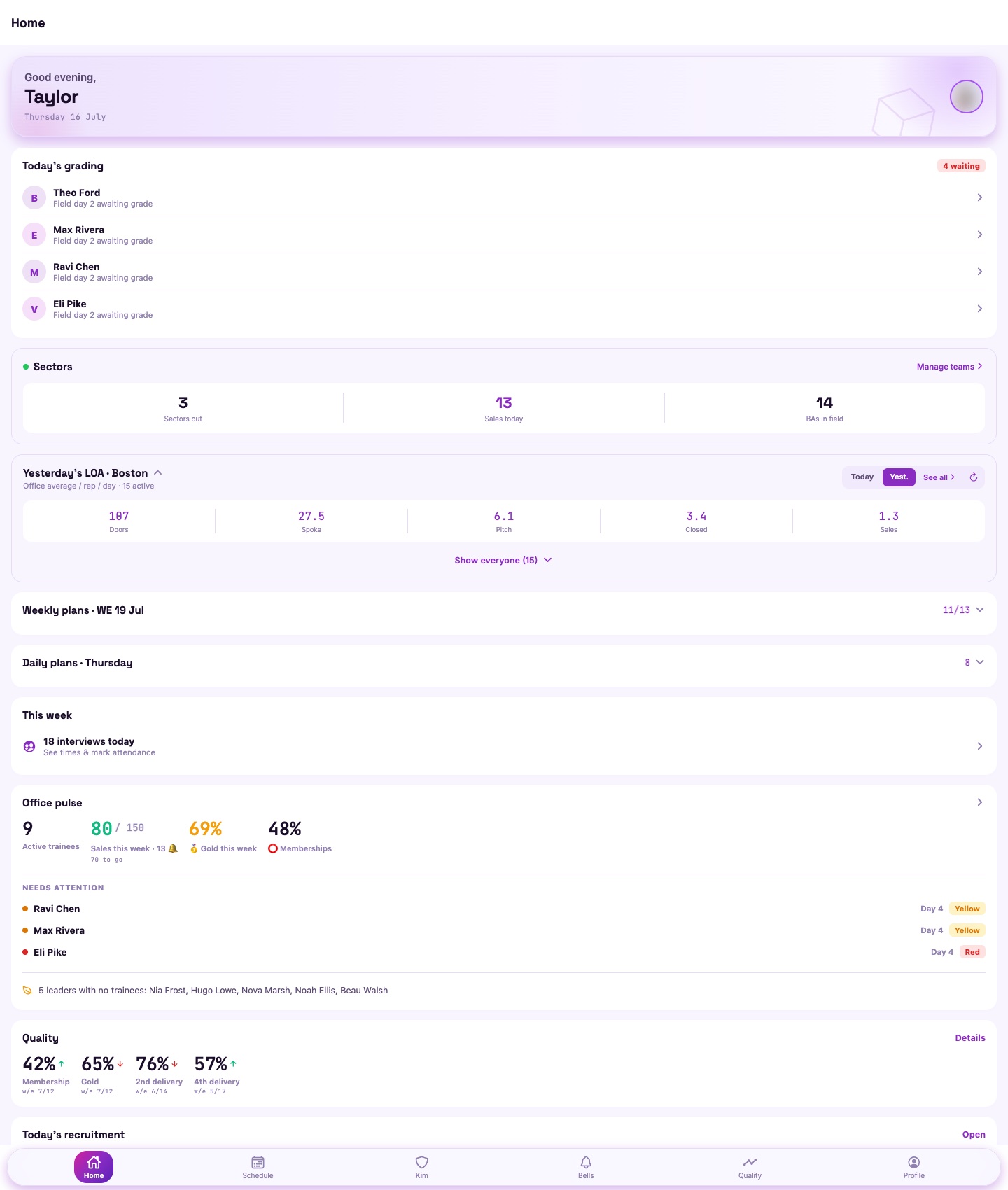
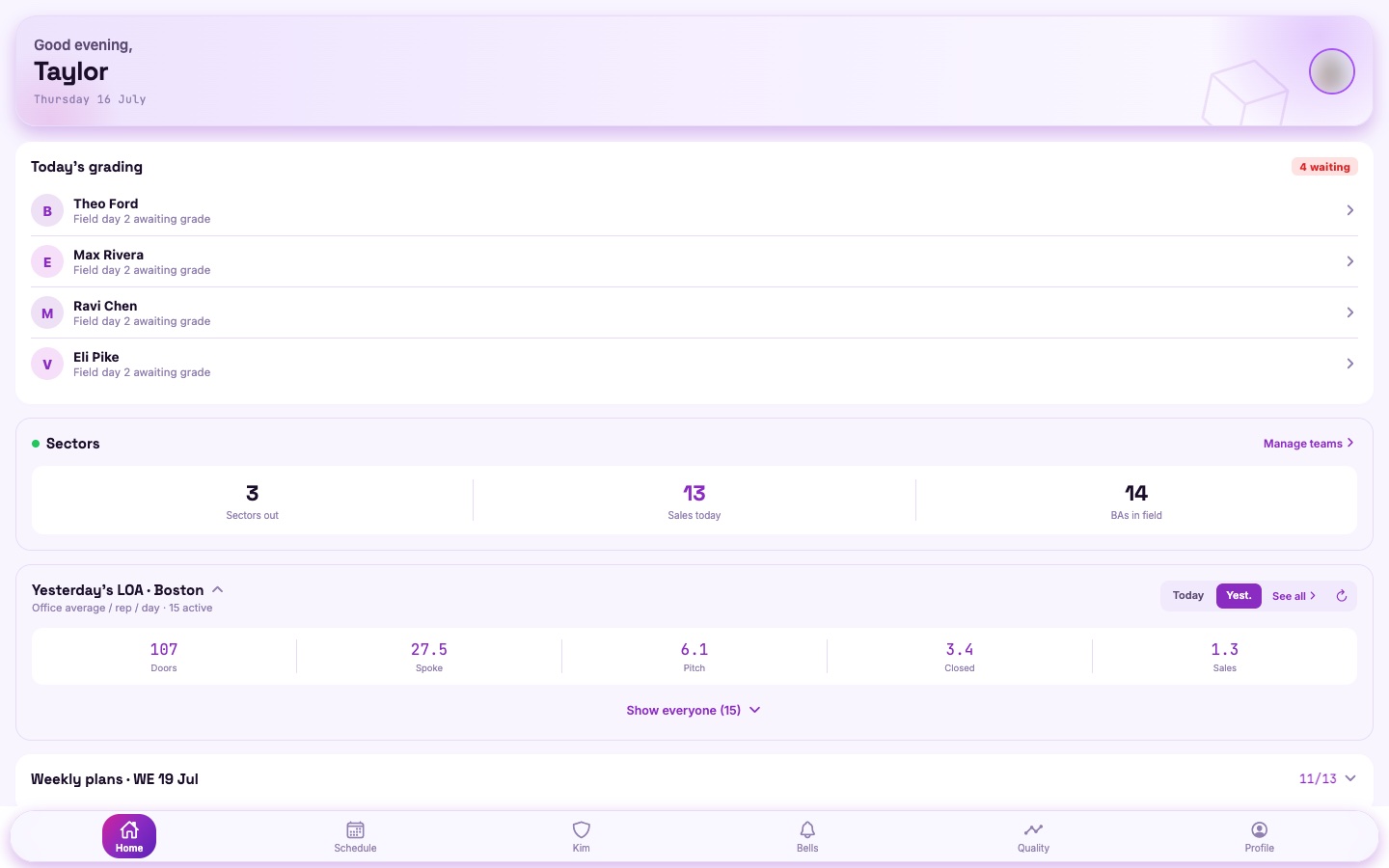
Training, team management, pay, quality, planning, recruiting and live field operations. CG1 is role-aware: the same app shows a trainee their journey, a leader their team, and an admin the whole office. Pick a role and take the tour.
What: a briefing screen that knows who you are — journey, schedule and next actions. Why: new reps used to land on raw scores with zero context; now day one starts with "here's exactly where you are."
What: welcome word, first-weeks timeline, pay explainer, people-to-know with tap-to-call. Why: the first 48 hours decide retention — this replaces "ask around" with a guided path. Admin-editable per office.
What: structured orientation + field days, each graded daily by a leader against benchmarks. Why: consistent training quality across every leader and office — nobody falls through the cracks.
What: exact payroll math (per-delivery fees, volume/$30+/Round bonuses, week-pays-when cadence) with live office rates. Why: reps who can forecast their cheque trust the program and push for quality sales.
What: the full training manual in-app (admin-editable), product-knowledge exams, client facts. Why: one source of truth for what we say at the door.
What: the day-sales ladder the floor already uses — sale, bell (3), gong (5), superstar (10) — as leaderboards and badges. Why: celebrates outcomes, not streaks; recognition matches the office vocabulary.
What: an in-app coach for scripts, objections and product questions. Why: the answer at 7pm on a doorstep can't wait for tomorrow's cube-up.
What: real doorstep conversations, recorded and AI-coached — searchable transcripts that jump to the exact second, tap-any-word playback, and daily summaries like "in 5 of 8 failed pitches you accepted the first no." Why: coaching built on what was actually said at the door, not on memory of it.
What: a 10:00 push with today's intro / pitch / sales targets, and a "This week" pay card with estimated earnings and an on-pace projection. Why: every rep starts the day knowing their number — and what hitting it pays.
What: personal bottom-bar layout, light/dark brand themes, push notifications, and an in-app inbox with per-type notification controls. Why: a tool people shape themselves is a tool they open every day.
What: every ungraded trainee-day on Home, earliest first, "N days behind" flags, one tap into the assessment — and read-receipts showing which trainees actually read their feedback. Why: grading discipline is what makes the 8-day program real — this makes skipping it visible.
What: if bells show a trainee was in the field but their day is ungraded, the leader gets a push every ~3h until it's done (quiet overnight). Why: the system chases the paperwork so admins don't have to.
What: live view of every team out today — combined funnel, per-BA rows, and door-by-door laps with outcomes and timestamps. Why: a leader can coach at 4pm based on what happened at 2pm, not at tomorrow's meeting.
What: doors → spoken → pitch → closed → sales per rep, with date presets, office filters and team averages, synced hourly from the client's platform. Why: funnel ratios show exactly which conversion step each rep needs coached on.
What: goal planners auto-filled with real LOA averages for the review week, plus an AI planning coach. Why: targets grounded in each person's actual run-rate stick; wishful ones don't.
What: CGRecruit pipeline access, interviews-today on the Home checklist, add-applicant flow, and Book a Starter — a confirmed hire lands straight onto CGRecruit's training board, roster and confirmation comms in one tap. Why: leaders grow teams — recruiting sits next to managing, not in another login.
What: the Cycle of Development as a real course — impacts grouped by stage, a step-through Learn mode, and AI-generated Quick Checks graded server-side, all behind a searchable Library. Why: leadership development stops being tribal knowledge and becomes a curriculum.
What: one row per person per day — learning, teaching or watching, on what topic, with whom — visible to the whole office. Why: development sessions get joined, not duplicated in private notes.
What: name your team in Profile and it's created on the client's platform automatically; assignments and promotions sync too. Why: one action in CG1, zero double admin.
What: actives, sales today, quality trend, recruiting funnel and team-health flags on one briefing screen. Why: the morning "how are we doing" question answered before the first coffee.
What: daily sales entry that powers leaderboards, attendance history and the reminder engine. Why: one entry point feeds gamification, grading discipline and reporting at once.
What: per-rep gold %, membership %, cancels, 2nd/4th-delivery retention vs the 80/65 standards, doorstep-photo and delivery-instruction rates, weekly quality bulletins — plus an append-only ledger of every delivery date the client's sheet quietly changes. Why: the client pays for quality — so quality is tracked as sharply as volume, and commission disputes can be reconstructed.
What: one page that closes last week and opens this one — office numbers, every leader's plan, highroller commissions recomputed live, and a top-down office target. Why: the Monday meeting runs off one screen instead of five spreadsheets.
What: natural-language prompt bar ("Sam's report for last quarter") → full individual or team report; numbers computed in code, AI writes the narrative only. Why: hours of report-building collapsed into one sentence — with numbers that can't hallucinate.
What: hourly KPI import from the client's field platform, plus automated writes — promotions, deactivations, team creation and reparenting fire automatically from CG1 actions, with a nightly reconcile sweep. Why: the client's system stays perfectly in step without anyone touching it.
What: user management, promotion flow (email + push), mass orientation grading (a whole class in one confirm), the badge maker with QR codes, offer letters, and the new-hire pipeline from CGRecruit. Why: from "interview passed" to "badge ordered" without leaving the app.
What: team and quality bulletins with a one-tap Monday share (all three images in a single share sheet), plus in-app editors for the manual and the onboarding hub. Why: the office's living documents are owned by the office — no developer needed to change a word.
What: office scheduling with audience targeting, plus a live Territory entry — doors worked today at a glance and one tap into CGTerritory. Why: where we knock and when we work, planned in the same place.


02 · The recruiting engine
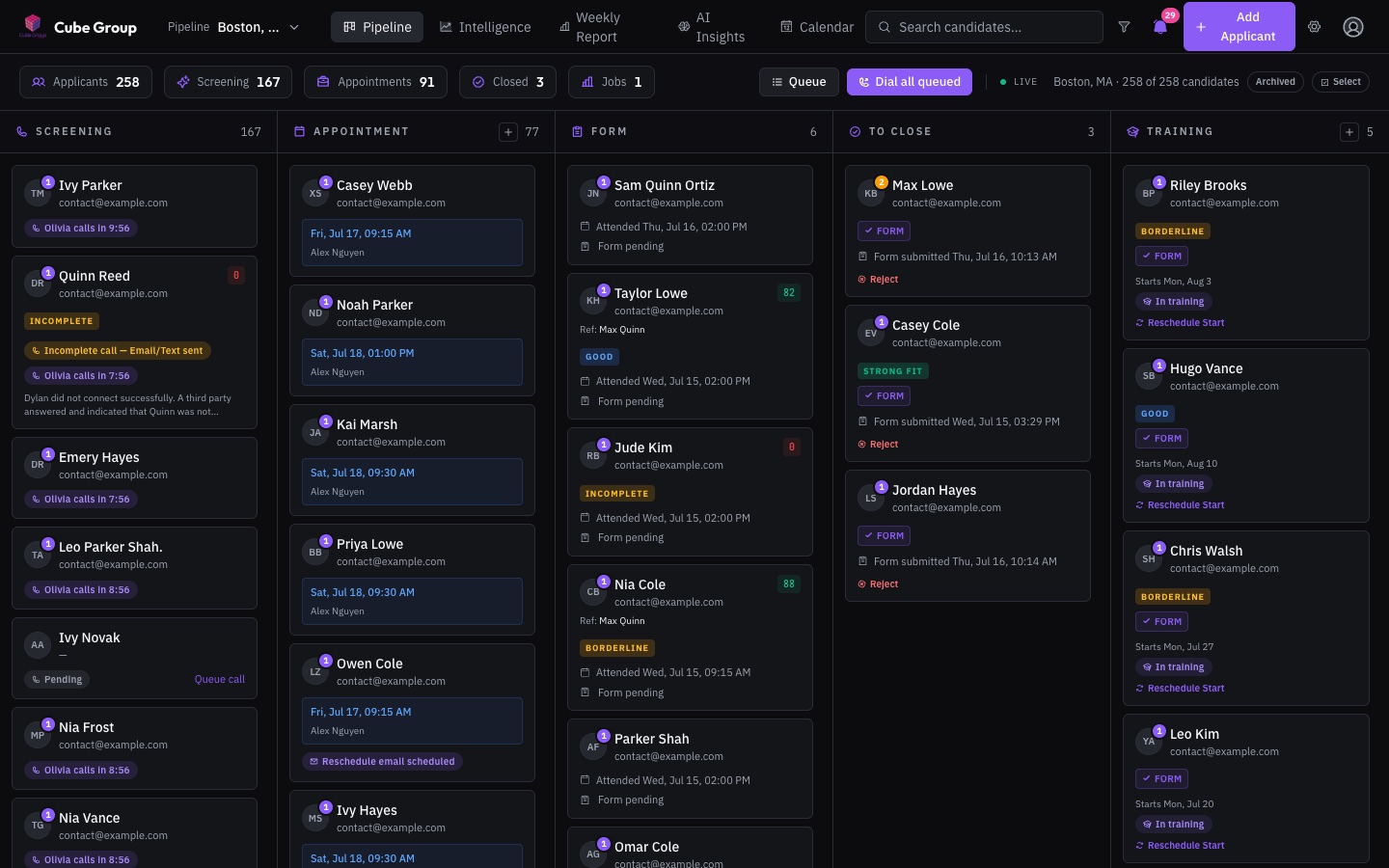
Every applicant hears from Olivia, our AI agent, within minutes — a screening text conversation or a real phone call, whichever the office runs. She screens, scores, books the interview, sends reminders, answers the office line, and even calls back the no-shows. Recruiters manage a pipeline, not a phone.
What: an ElevenLabs-powered agent calls every applicant, runs a real screening conversation, and books interviews into live availability mid-call. Why: speed-to-contact decides recruiting — Olivia calls in minutes, 7 days a week, and never has a backlog.
What: voicemail triggers an instant DND-bypass redial; unreached candidates re-enter on a tuned cadence (1h → 2h → 6h) with per-pipeline and global concurrency caps. Why: persistence without spam — tuned to how people actually answer phones.
What: screening runs as a conversation wherever the candidate is — SMS or web chat with tap-to-answer chips — merged with any call into one thread, producing the same score and verdict as a phone screen. An office flips between chat-first and voice-first with one switch. Why: a generation that won't answer unknown numbers still gets screened in minutes.
What: a per-office agent that answers the office line — recognizes the caller, answers business questions, resumes an unfinished screening, reschedules interviews or training dates by voice, and registers brand-new callers mid-call. Why: the phone gets answered on the first ring, every time, even mid-rush.
What: Indeed applications flow in unattended (resume included), a one-click daily run sends ranked sourcing invites, and outreach replies are triaged automatically. Why: the biggest job board works for us around the clock without a recruiter logged in.
What: transcripts scored against plain-English criteria, plus an Intelligence view and funnel reports across the whole pipeline. Why: recruiter time goes to the best candidates, and the funnel tells you where you're leaking.
What: availability manager, slot-picker & reschedule links by SMS, per-slot interviewer names resolved live from the calendar, attendance tracking, automated reminders — and an empty-room alarm when a session has bookings but zero confirmations. Why: every manual scheduling touch removed is an interview that actually happens.
What: every booking confirmation links a personal portal — live countdown, add-to-calendar, what-to-expect guidance, and the recruitment deck to reread. Why: candidates who arrive prepared show up more and convert better.
What: a second AI agent that calls archived no-shows for weeks after (3 attempts, daily caps) and rebooks them. Why: no-shows were the biggest leak in the funnel — now they get a second chance automatically.
What: referral links per city (used by the website), an embeddable apply widget, custom application forms, email intake, and manual add. Why: wherever a candidate comes from, they land in the same pipeline within seconds.
What: per-pipeline AI prompts, stage prompts, comms templates, starter emails, team & analyst access, region/language settings. Why: new office, new market, new script — configured in Settings, not re-coded.

04 · Territory intelligence
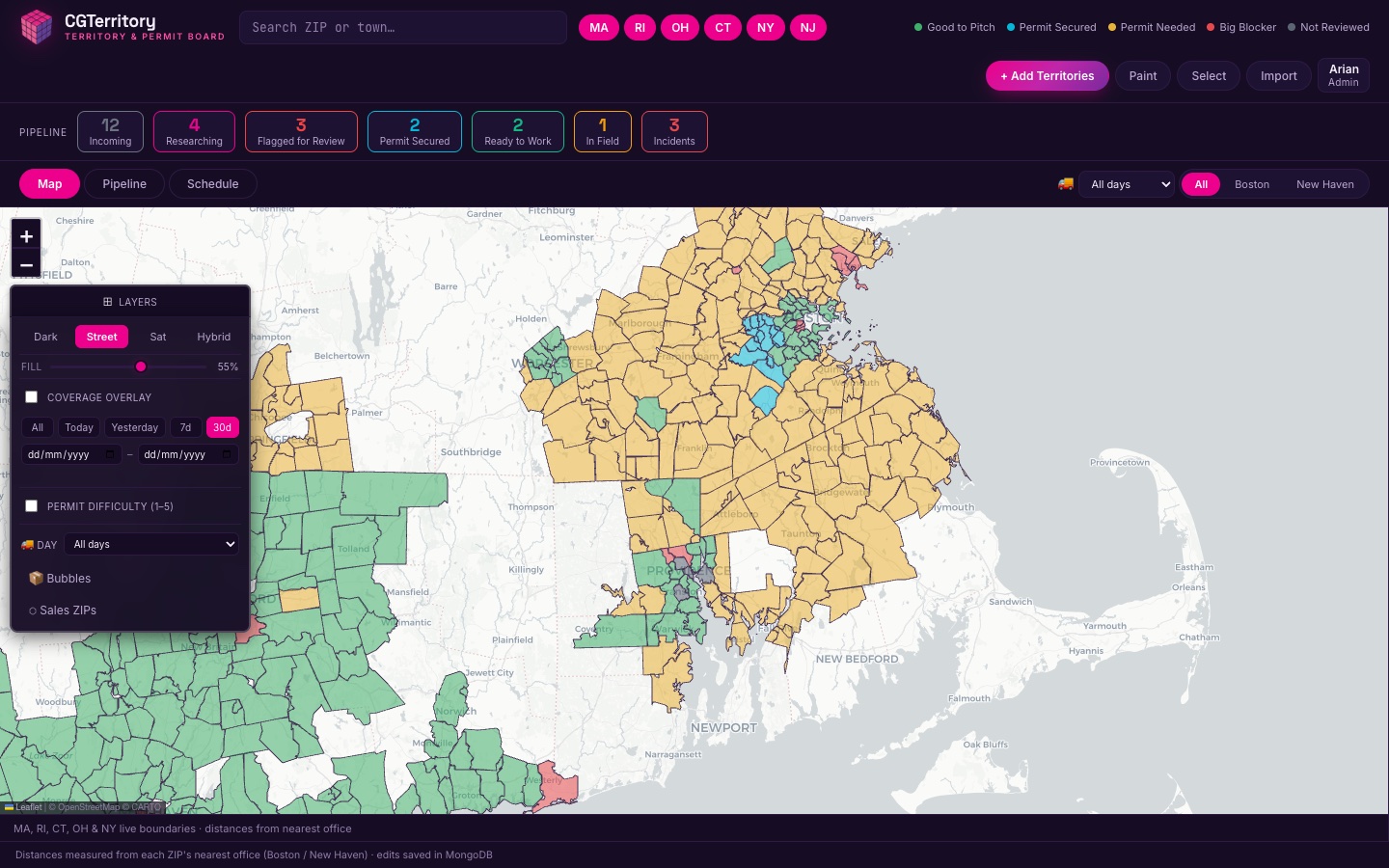
A live territory & permit board for door-to-door operations: which ZIPs we can work, what each town's permit status is, every door we've knocked, every sale we've signed, and where we must never knock — all on one shared map.
What: every ZIP as a colored polygon — cleared, pending, restricted, no-go — shared live across the whole team. Why: canvassing without a permit costs fines and reputation; now the answer is one glance, same for everyone.
What: every door logged in the client's field app appears as an outcome-colored pin — synced hourly, geocoded to the house, filterable from today back six months, with a topbar "Sync doors" for right now. Why: end-of-day marker-pen coverage became live ground truth — 180,000+ real doors, served instantly.
What: every ZIP carries its distribution hub, and a Balance view tracks sales against each hub's per-delivery-day cap, with a "Workable" mode that orders days stalest-first. Why: the client's delivery capacity is the real constraint — now we plan inside it instead of discovering it.
What: a ZIP with a strong sales week auto-moves to In Field, re-adding a recently-strong ZIP raises a "Resting" warning, and constraint chips roll up into a client-facing Zipcode Feedback view. Why: the board maintains itself — and the client sees exactly why each ZIP waits.
What: paint statuses directly onto the map, box-select regions, customize the color scheme. Why: managing hundreds of ZIPs has to feel like a map tool, not data entry.
What: built-in researcher that searches town ordinances for solicitation rules and files findings per ZIP. Why: hours of clerk-website reading collapsed into a button.
What: CSV/Excel upload, a template, and “Extract with AI” for messy client lists pasted straight in. Why: client territory lists arrive in every format imaginable — all of them work.
What: DNK addresses and field incidents geocoded to house-level ✕ pins, typed and filterable map-wide, with bulk import. Why: compliance is enforced where the work happens.
What: knock coverage with date-range filters, per-sale pins from the client's invoicing sheet with delivery-status chips, and sales-by-ZIP from CG1. Why: shows where to re-knock, where converts best, and where's saturated.
What: role-based users with branded email invites, an installable home-screen app that opens offline in the field, per-user saved map preferences, and a shareable map export view. Why: the ops team, leaders and the client can each see exactly what they should — on any device.


01 · The front door
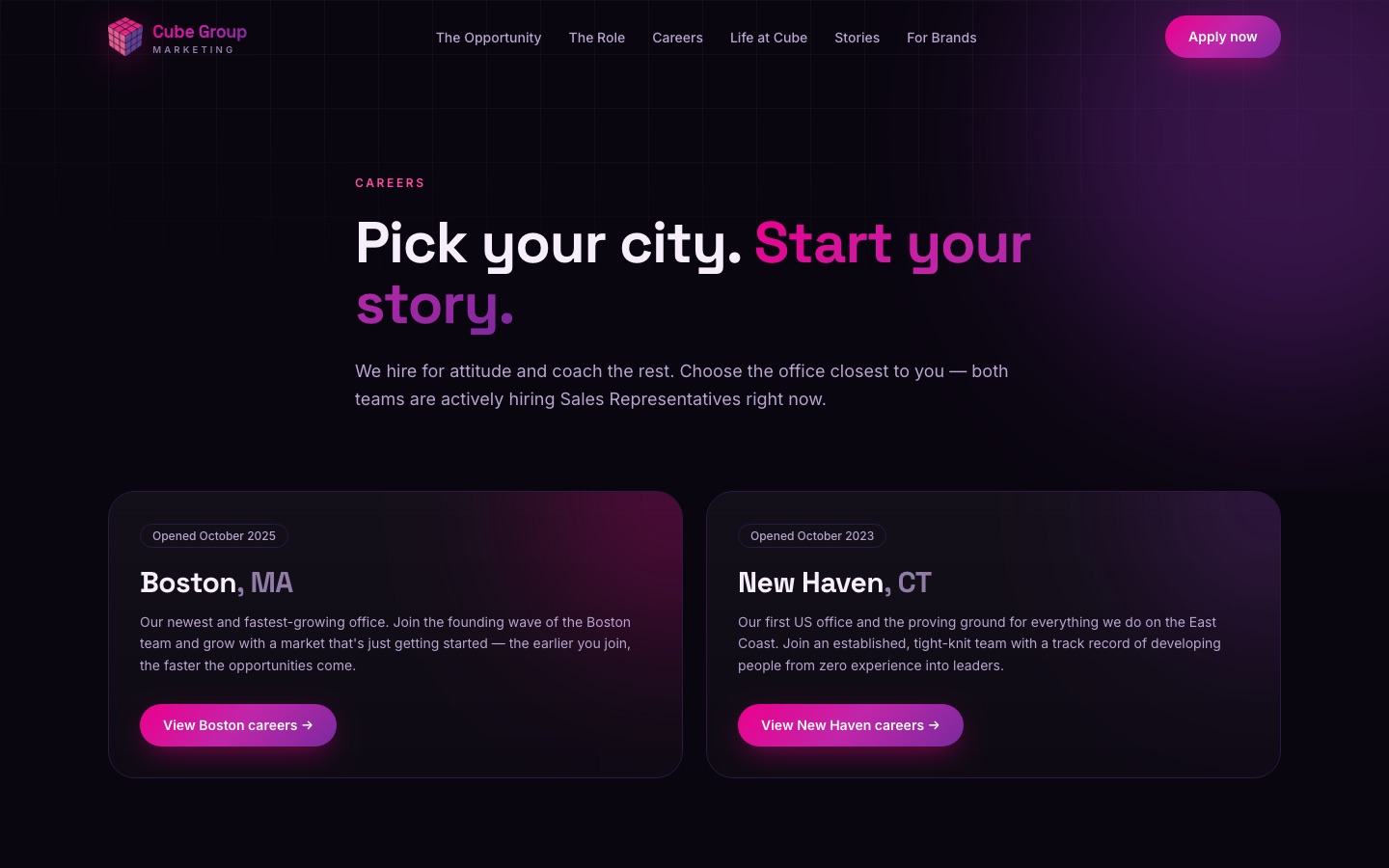
Candidates research before they apply. The site is built recruit-first: it answers "is this legit?", shows real people and real reviews, and funnels every visitor into CGRecruit in two clicks.
What: home, careers + two city pages, our-story, for-brands, and a Stories blog — all written for the applicant researching us. Why: the best candidates Google before they apply; the site is the first interview.
What: city chooser → CGRecruit referral intake; optional embeddable apply widget; mobile floating Apply bar. Why: zero friction between "interested" and "in the pipeline."
What: live Google reviews, live Instagram feed, real client logos, a personal note from the team. Why: authenticity beats stock photos — everything on the page is verifiably real.
What: structured data (Organization, FAQ, JobPosting, BlogPosting), sitemap index, robots, OG images, branded-search content. Why: owning the search results page for our own name is recruiting defense.
What: a password-gated planning tool — real cost base, the current fee grid, adjustable sales mix and headcount, with head-office rates behind a second password. Why: "what does an office actually make" answered with live numbers, safe to hand a partner.
What: privacy policy with CTDPA + recruitment-data coverage, terms, EEO statements on careers pages, and hardened security headers site-wide. Why: we ask for applicants' data — we treat it like it matters.
What: the architecture is reused for branch-office sites (their own brand, same engine, same CGRecruit intake). Why: a new office can have a full web presence in days.


05 · The stage
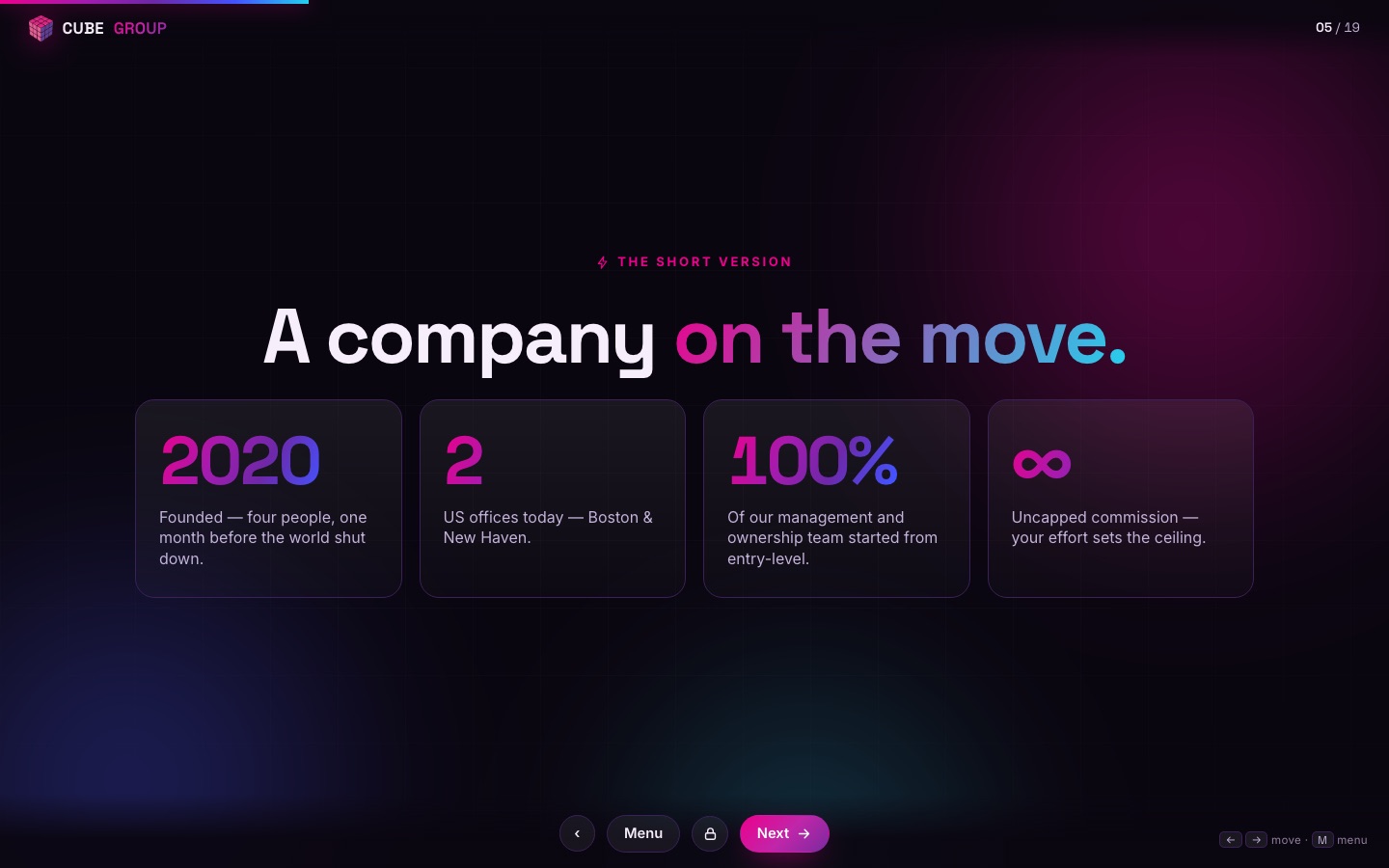
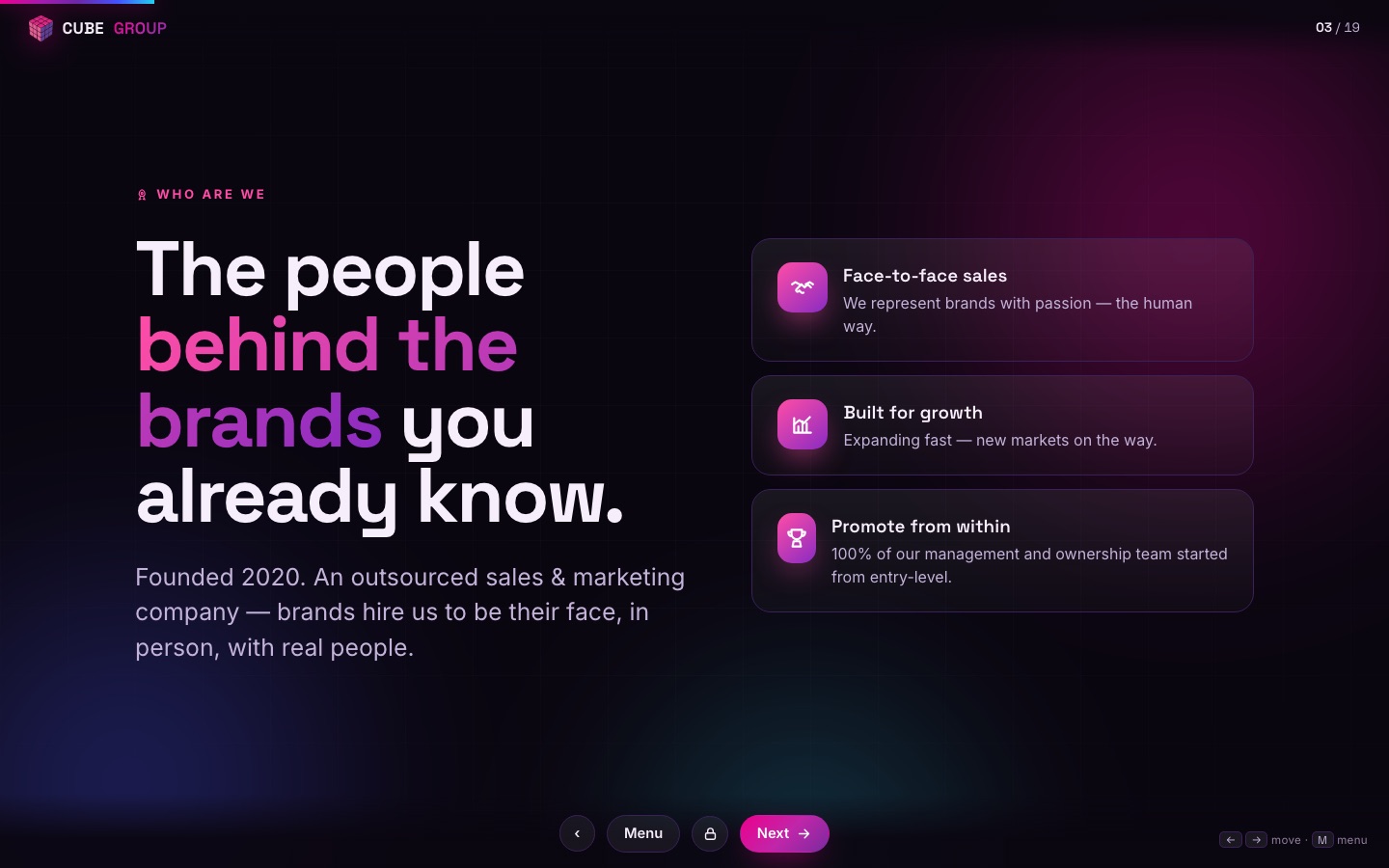
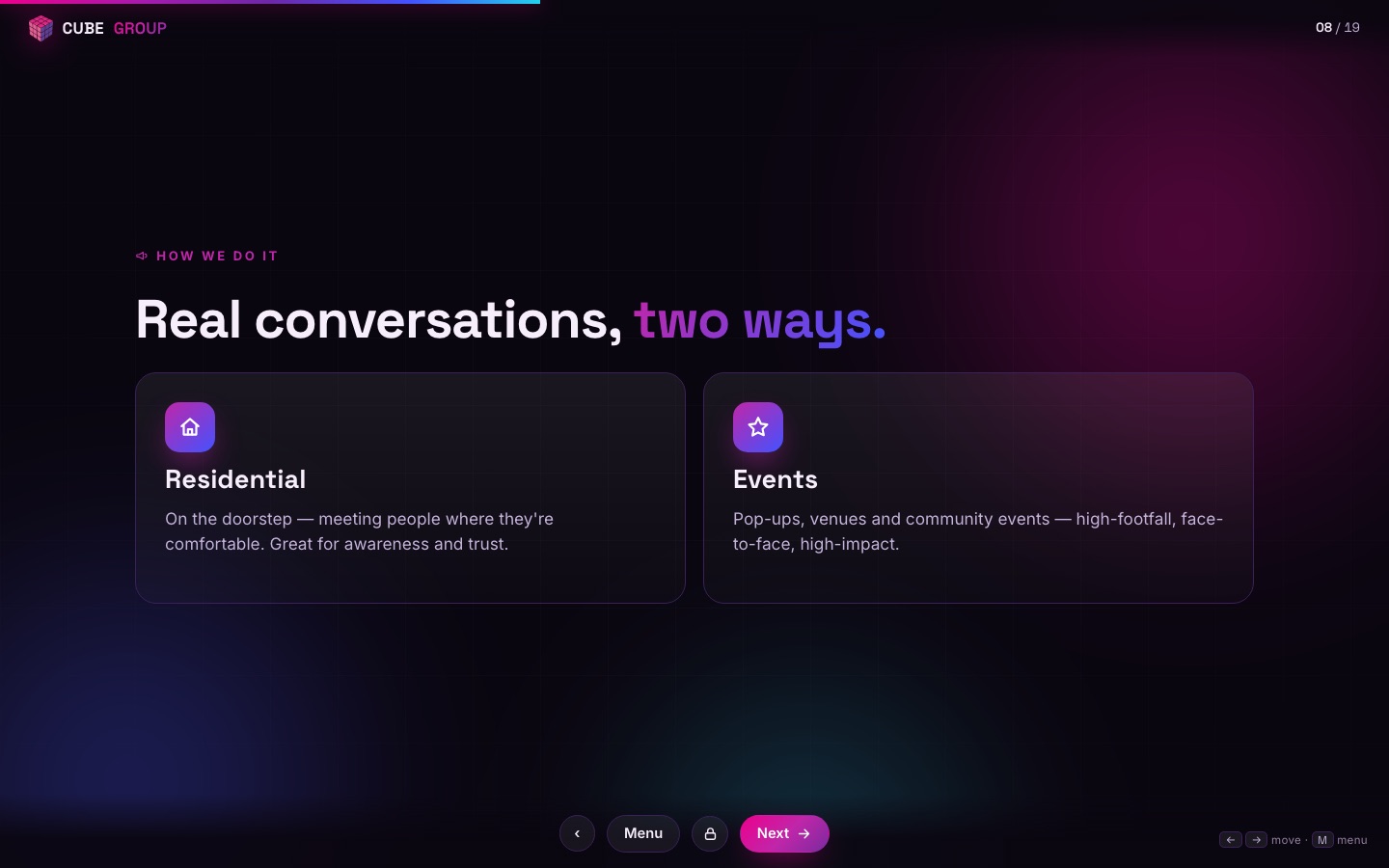
The recruitment presentation and the full product-training deck, rebuilt from a 552 MB PowerPoint into a fast, gated, editable web platform. Present from any laptop, edit from any browser, never email a .pptx again.
What: the interview-day presentation as a public web deck, with the presenter script password-gated. Why: every presenter runs the same polished deck from any device — no version chaos.
What: 54 slides across 5 parts with pop quizzes, galleries, video, the Rehash script and the first-8-days roadmap — fully password-gated for the team. Why: training day is standardized across offices and always up to date.
What: the exact CG1 pay math embedded as an interactive slide. Why: "how much will I make" answered with sliders, not promises.
What: true fullscreen present mode plus a pop-out speaker view with notes and timer. Why: professional delivery with zero setup.
What: click-to-reveal builds, a speaker view that follows the build point by point, video slides, and a lite mode for older machines. Why: the web deck now beats the .pptx it replaced at its own game — and the fee cards on it are always the current rates.
What: admin-gated live editing — text with size/bold/italic styling, reorder, add/hide slides — stored as per-deck overlays on a persistent volume; per-office deck variants. Why: the deck evolves as fast as the pitch does, without a developer in the loop.


The proof
Here's what the stack does for one person — automatically.
Under the hood
Every product ships from its own repo to our own infrastructure — push to deploy in minutes, verified by version endpoints. No agencies, no vendors between an idea and production.
The plum-and-magenta system — Space Grotesk display, Inter text, JetBrains Mono for data — is mirrored across every app, email template and deck from a single token set.
Voice & text screening, an inbound front desk, no-show revival, doorstep-conversation coaching, permit research, territory parsing, performance narratives, planning coaches. Rule everywhere else: numbers computed in code — AI never invents a stat.
Trainee / leader / admin scoping runs through every backend — people see their team, admins see their office, and office data never crosses over.
Trial logins see everything and can change nothing — every write is refused platform-wide — and super admins can preview CG1 as any trainee or leader, read-only. Walking someone through the real stack never risks real data.